Be yourself; Everyone else is already taken.
— Oscar Wilde.
This is the first post on my new blog. I’m just getting this new blog going, so stay tuned for more. Subscribe below to get notified when I post new updates.
Be yourself; Everyone else is already taken.
— Oscar Wilde.
This is the first post on my new blog. I’m just getting this new blog going, so stay tuned for more. Subscribe below to get notified when I post new updates.
The ISC2 is a highly respected organization that provides security-related, vendor-neutral certifications. The ISC2 certification program is based on the Common Body of Knowledge (CBK) which is a framework for defining industry standards and security principles.
The (ISC)2 Certification Program offers five core security credentials:

An ISC2 certification begins with the SSCP certification. You can be granted the associate of ISC2 credentials if you pass the ISC2 SSCP certification. ISC2 certifications are career-boosters for professionals starting a career in the security field. ISC2 certified professionals earn an average of 35% more than their non-certified counterparts. There are more than 38,000 jobs in which employers prefer or require a CISSP certification, and these numbers will continue to increase in the coming years.
Here is a brief idea about the ISC2 certifications:
The ISC2 CAP certification is a leading information security certification that proves your expertise in dealing with risks and vulnerabilities. The ISC2 CAP certification proves your knowledge, skills, and abilities to authorize and maintain information systems within the RMF.
The ISC2 SSCP Certification is an advanced-level credential specially meant for IT security professionals. The ISC2 SSCP certification validates the technical skills to implement, monitor and administer IT infrastructure using information security policies and procedures.
ISC2 CSSLP is the only certification in the industry that ensures a professional’s skills in incorporating security throughout the entire lifecycle. The CSSLP certification exam involves the concept of secure software concepts, software requirements, software designing, and so on.
The ISC2 CISSP certification is a globally recognized standard of achievement in the industry. The ISC2 CISSP certification demonstrates your knowledge, advances your career and help you become a member of a community of cybersecurity leaders.
ISC2 CCSP is the globally acknowledged industry’s premier Cloud Security certification. It validates advanced technical skills to design, manage, and secure data, applications, and infrastructure in the cloud.
Get yourself enrolled in our comprehensive courses that will help you prepare for these certification exams with their comprehensive learning resources.Posted in CCSP, CCSP, CCSP Certification, CISSP, Cybersecurity, ISC2, ISC2, SSCP, Study Tips.Tagged CCSP Certification, CISSP certification, ISC2, isc2 certification training, isc2 cissp online training, SSCP cert guide, SSCP online training.
These days, it’s no longer possible to deny the role your employees have in keeping your data – and your business – safe. Cybersecurity training programs are now more critical than ever. With that in mind, though, you need to ensure your own training isn’t missing the mark. Let’s talk about that.

Cybersecurity training is critical, now more than ever. You’re doubtless already aware of that – you probably even have a program in place to teach your staff the basics. And that program is probably missing quite a bit.
Fact is, most businesses seem to focus solely on the informational side of cybersecurity training. But if you want your training to be effective – if you want it to resonate with your workers – you need to take things further. You need to focus on what your training – on what most training – is missing.
Phishing is one of the most common cyber attack tactics for a reason – it works. It doesn’t take much for even a well-informed person to fall victim to a phishing email, either. Stress-based carelessness and simple fatigue impact us all at one point or another.
Security awareness education and training simply aren’t enough to mitigate this threat. Sure, teaching people about some of the common tactics used by scammers can help them better recognize the signs that they’re being targeted. But at the same time, it won’t address the incaution that ultimately makes phishing successful.
Instead of solely focusing on information, your training should also focus on mindfulness – on teaching your workers to think differently and be more cautious in how they conduct themselves. This need not apply just to cybersecurity, either. Framing your exercises as a way your staff can further enrich their personal lives can go a long way towards helping them embrace it.
The cybersecurity market is in constant flux. Every day, new threats emerge, new tactics by which hackers may attempt to compromise your organization. It’s your job to stay abreast of these threats – to pay attention to security researchers and media releases so you can better stay on top of things.
But how exactly does any of this apply to employee training programs?
Whenever a major breach occurs or a major vulnerability is revealed, discuss with your team how the target may have done things better. Keep your training material up to date with lessons that may be gleaned from those breaches.
Last but certainly not least, you need to make your training something employees will actually want to bother with. Establish why your training program is important – why your workers should pay attention to it. Be transparent about why security matters, and about their agency and role in keeping your business safe.
Beyond that, your goal should be to make them actually feel motivated to engage with whatever programs you’ve implemented. Create an interesting narrative that focuses less on the technical side of cyber attacks and more on stories of what happens when cyberattacks succeed. Know and understand the sort of things your staff finds interesting, and structure the narrative on that.
And of course, there’s gamification – that buzzword everyone’s on about. By offering incentives and rewards, visual aids, and entertaining activities, you can get people far more interested in your cybersecurity processes and policies than you ever could with simple information.
Too often, businesses treat cyber training as a way to simply vomit information at their staff. This rarely works. In order for your cybersecurity training programs to actually be effective, you need to go a little further. You need to focus on the above items – on exactly what you’re missing.
Most of the time, marketers are believed to be creative geniuses who are able to produce ideas by putting their innovative skills to work, without possessing too much organizational or project management talents.
While this can be true in some cases, as even John William Gardner once said that “Creative minds are rarely tidy”, it is precisely creativity that can help the creative content marketers turn into strong project managers. With a little bit of discipline, planning, and teamwork, combined with your creativity, you can turn project management into a piece of cake.

Below are some tips to help you achieve your goals and keep your team focused.
Don’t Over-complicate Things
The road to reaching the best results is often the simplest one. When developing a project, you don’t have to come up with complex charts and plans, but simply create a formula and stick to it. A simple only needs to contain an outline of the entire development of the project, split up into steps. This is as simple as it can get:
Have Clearly Defined Goals
In order for you and your team to know what type of projects are worth putting your effort into, you need to have clear goals and be aware of what you want to achieve. For example, if your main goals are to increase traffic and subscribers, while also build a larger customer base, you need to put all your time end effort into projects that will help your business achieve that.
Make sure to keep your goals reasonable and realistic, otherwise, you might find yourself biting more than you can chew. If you present your team with a list of 15 projects that need to be accomplished by the end of the week, they might not know exactly where and how to start working towards them. And, most importantly, they might not know which of them are going to better help the business achieve the set goals.
This is why prioritizing is extremely important. To prioritize your project, you can choose a simple rating method, where you can list all your projects and rate them on a scale of 1 to 5. “5” means the project will significantly help you achieve your goals, while “1” means it can probably wait a bit more.
Evaluate Your Resources
After you have decided on a project, it is time to determine what resources go into its development. This includes tools and budget, as well as talent. Your project should not be influenced by the resources, but the other way around.
“Projects that could really impress your audience should not be set aside, just because you don’t consider you have the necessary resources. Instead, work towards obtaining them. This is where the creative genius inside you has to come out and do what it knows best: get creative,” says James Daily, head of the content department at FlashEssay.
Keep in mind that sometimes, it is better to concentrate all your resources towards a project that could drive immense growth for your business, rather than divide them into multiple projects that will only drive moderate growth.
Schedule Your Tasks
When working at a project, you might find it more effective to break the project into separate tasks and set deadlines for them. This way, you can focus on finishing them in order of importance for the main project.
Hold a meeting with the entire team involved in the project execution and start splitting the tasks based on each member’s skills. This way, you can make sure that everyone is contributing to the project in the best possible way. Make sure to ask for time estimates as soon as everyone knows what their task is, in order to make sure you will hit your deadline.
It might be best to plan everything with a calendar that everyone has access to, in order to get things done in a more effective way. This will ensure that everybody knows exactly when the deadline is, what their tasks are what other important events might happen along the way. On the other hand, this will give you a clear view and, in case something does not go as planned, you will know whom you need to talk to.
Plan Constant Reviews
In order to avoid unplanned situations, such as one member of the team not completing their task, you need to constantly review the progress.
“Simply asking everybody where they are with their task can sometimes be enough to give you a clear idea, but it is better to schedule regular meetings, in order to gather the whole team and receive updates on their progress. Based on the deadline, the meetings can be scheduled daily, twice a week or even weekly,” advises Veronica Wright, CEO at Resumes Centre.
Good creative content gets done better when you have a clear strategy in mind, and by applying project management methodologies, you can achieve exactly that and much more. This way, deadlines will not be a scary date on a calendar anymore, but a clear milestone towards your final project.
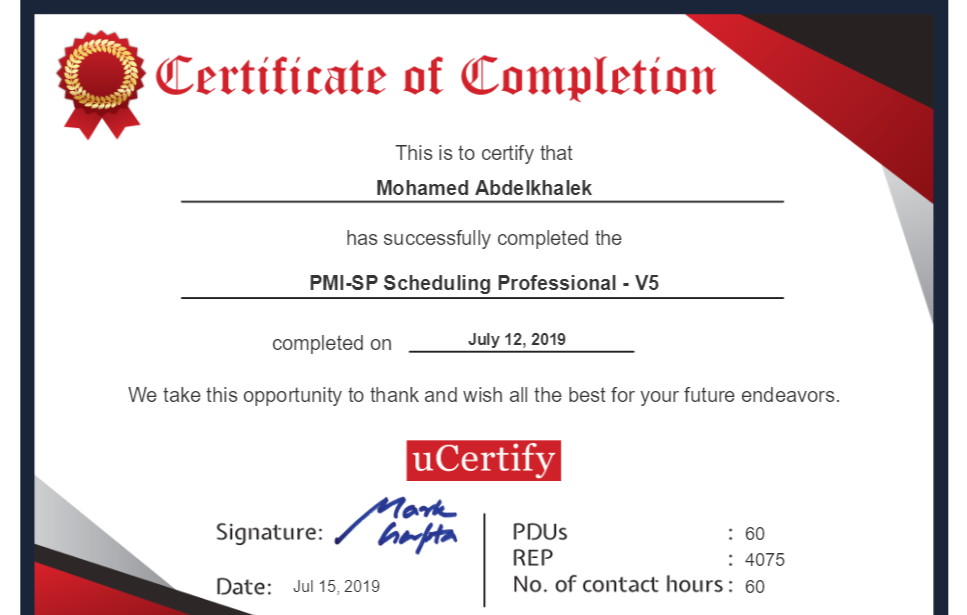
It gives me great pleasure to write my recent experience with Ucertify platform for the first time.
As an experienced Civil Engineer, I was seeking for a career shifting to planning and project control department, so I was indeed seeking for a powerful course content that could clearly put me in the right way of the next level of my career journey.
The course content is very valuable and seems to be as a result of years of practical experience of the professional instructor. I really like the methods of how the course fastens the new knowledge to students such, Cards, Quiz and Exercise are very helpful to memorize the new gained information by different ways.
I must also make a note of the platform design. It is very friendly to use and more than clear to handle. It should be noticed, that I have registered for many online courses at several online platforms and Ucertify surprised me as the course was very organised, well discussed on all related topics and presented in a professional way that facilitate the course content to audiences.
I highly recommend this preparation course for professionals who look for the globally recognized accreditation certification of PMI-SP as it will deepen their knowledge and increase their chances to pass the exam from the first trial.

 Mohamed Abdelkhalek